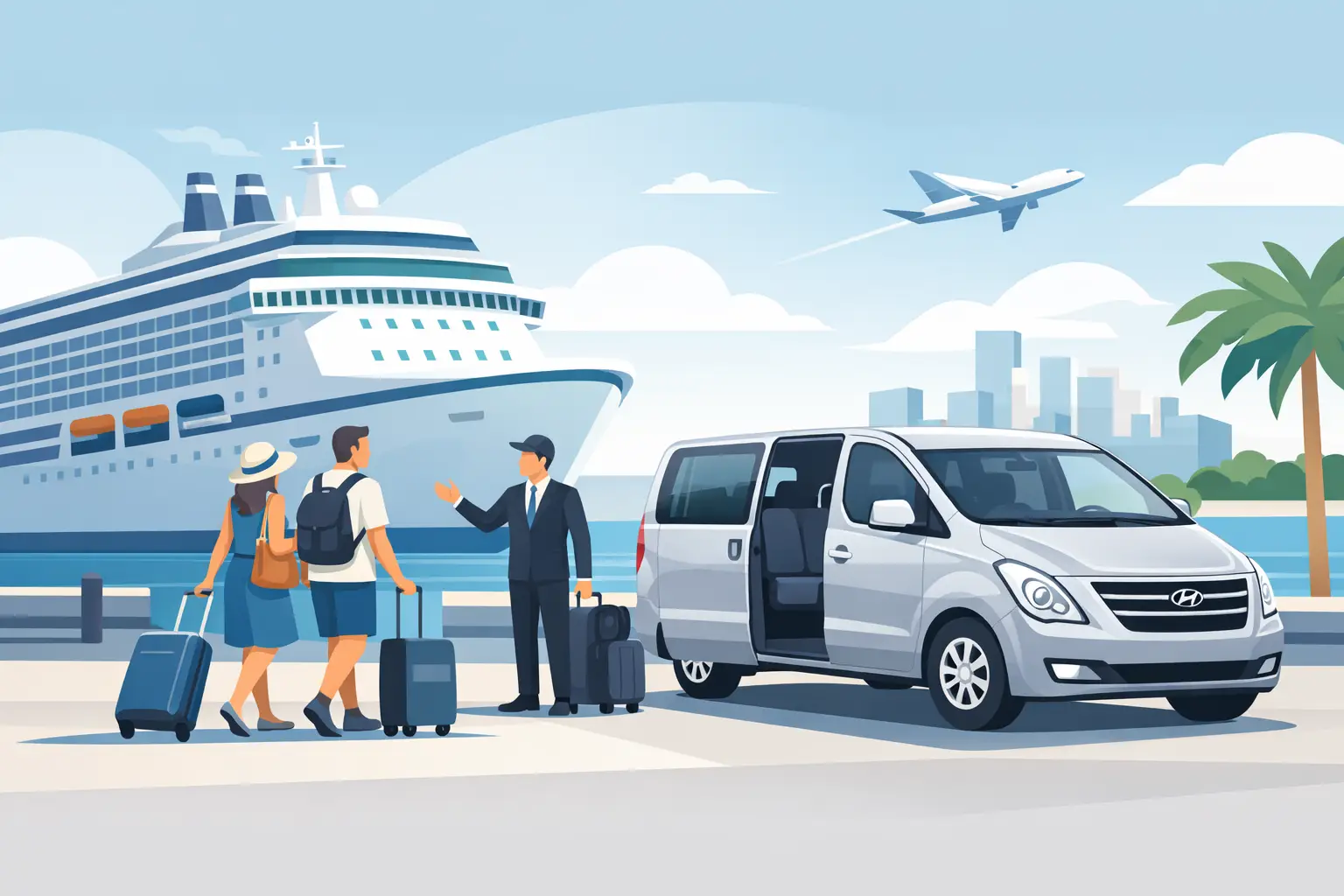
A cruise should begin at the terminal, not with a stressful search for a car large enough for four cases, hand luggage and the family. The best transfers for cruise passengers are planned around real travel details: your embarkation time, the port entrance, your luggage, your party size and the journey before or after you sail.
For passengers travelling through Liverpool, that often means connecting a home, hotel, airport or railway station with the cruise terminal at a fixed, agreed price. A pre-booked private transfer gives you a named plan for the day rather than hoping an app-based car is nearby when boarding time is approaching.
What makes a cruise transfer the right choice?
The right transfer is not necessarily the cheapest fare shown on a screen. It is the one that gets everyone and everything to the right place with time to spare. Cruise travel has less flexibility than an ordinary city journey. Miss a train or arrive at the wrong terminal entrance, and the consequences can be expensive.
A good provider confirms collection details in advance, allows sensible time for traffic and port procedures, and sends a vehicle suited to the number of passengers and bags. Door-to-door service matters here. It means collection from your front door, accommodation or arrival point, then drop-off as close to the terminal entrance as access permits.
Fixed pricing matters just as much. With a pre-agreed fare, you know what the journey costs before you travel. There is no surge pricing because a ship is in port, no uncertainty over a long airport run and no awkward calculation while you are trying to check passports and luggage.
Best transfers for cruise passengers: private, pre-booked travel
For most families, couples, groups and business travellers, a private pre-booked transfer is the most practical option. You choose the collection time, tell the operator about your luggage and travel requirements, and travel together in one suitable vehicle.
This is especially useful when the cruise is only one part of a longer journey. You may be landing at Manchester Airport before travelling to Liverpool, staying in a city-centre hotel the night before boarding, or leaving the ship with a train to catch. A professional driver can build the journey around that schedule instead of treating it as a standard taxi job.
Modernist Transfers provides pre-booked, door-to-door journeys for cruise passengers travelling to and from Liverpool, with an agreed fare before travel. We remember that a transfer is often the first or last moving part of a carefully planned holiday, so the details are not left to chance.
Why on-demand taxis can be a gamble
An app-based taxi can be useful for a short, spontaneous trip across town. It is less reassuring for a cruise transfer, particularly at busy times, early in the morning or when several passengers have luggage. Vehicle availability can change, drivers may cancel, and the vehicle offered may not have the space you expected.
Price is another consideration. A fare that rises with demand offers little certainty when you are travelling on a fixed timetable. Pre-booking with a local private-hire company gives you confirmation, a clear collection arrangement and a fare agreed upfront. What we quote is what you pay.
When shared transport may suit
Shared shuttles and public transport can cost less for a solo traveller with light luggage and plenty of spare time. They may be a reasonable choice if you are happy to make stops, carry bags between platforms or work around a set timetable.
However, they are rarely the best fit for a family, an older traveller, a group, or anyone arriving after a flight. One delayed service can affect the whole chain of travel. A private transfer costs more in some cases, but it buys direct travel, luggage capacity and control over your time.
Four details to arrange before booking
The easiest cruise transfer is arranged properly from the start. When requesting a quote, have these details ready:
- Your exact collection and terminal details. Give the full address for collection and the cruise terminal or ship information where available. Ports can have different access points, so accuracy prevents avoidable confusion.
- Passenger numbers and luggage. Include large suitcases, cabin bags, pushchairs, mobility aids and any unusually sized items. The right vehicle is about space and comfort, not simply the number of seats.
- Your timing either side of the cruise. For embarkation, allow enough time for traffic, check-in and security. For disembarkation, tell your driver about train times, flight departures or hotel check-in plans.
- Any assistance you need. Let the operator know if someone needs extra time getting in and out, if children require appropriate seating, or if you would value meet-and-greet support after arriving by air or rail.
These small details allow a professional transfer company to organise the journey properly. They also mean your driver arrives expecting the trip you actually need, rather than trying to solve problems at the kerb.
Airport-to-cruise transfers need flight monitoring
Flying in for a cruise creates a timing challenge. Flights can land early, run late or take longer than expected for baggage reclaim. Booking a transfer based only on the scheduled arrival time can leave you waiting unnecessarily or worrying that your vehicle has gone.
For an airport-to-port journey, choose a service that monitors your flight and adjusts collection around its actual arrival. This is particularly helpful at Manchester Airport and Liverpool John Lennon Airport, where travellers may be managing luggage, children and unfamiliar surroundings after a flight.
Meet-and-greet support adds another layer of reassurance. Rather than searching through a busy pick-up area, you know where and how you will meet your driver. From there, the journey continues directly to your hotel, home or cruise terminal without a separate taxi queue.
There is still a practical limit: no driver can remove the risk of a seriously delayed flight arriving too close to boarding time. If your schedule is tight, consider arriving the day before and staying locally. A relaxed hotel-to-port transfer on embarkation morning is usually far better than trying to recover lost time from an inbound flight.
Group cruise transfers: keep everyone together
Groups often assume they need several taxis, then discover that coordinating different arrival times at the terminal creates more work than expected. An MPV or minibus can be the better answer, provided it is booked for the true number of people and bags.
Keeping the group together means one collection point, one driver contact and one arrival time. It is ideal for extended families, friends celebrating a special occasion and corporate groups travelling from an office or hotel. It can also be better value than multiple smaller vehicles once luggage and parking costs are considered.
The trade-off is that group bookings need more notice. Larger vehicles are in demand, and the vehicle must be selected carefully. Be clear if passengers are joining from different addresses, as multiple pick-ups affect both route planning and collection time.
The return journey deserves the same care
Disembarkation can feel less predictable than boarding. Ships may clear later than expected, passengers can take time locating luggage, and terminal areas can become busy quickly. The best approach is to arrange a realistic collection window and confirm the meeting instructions before you sail.
If you are travelling onwards by train or plane, build in a buffer. A transfer company can plan the road journey, but it cannot control how quickly the ship is cleared or how long luggage collection takes. Giving yourself breathing room turns the end of a holiday into a comfortable journey home rather than a race against the clock.
For a return to the airport, share your flight time and airline check-in requirements when booking. Your driver can then collect you at a sensible time and help make the final connection feel straightforward.
Choose certainty, not just a ride
When comparing cruise transfers, ask simple questions. Is the fare fixed before travel? Is the vehicle suitable for all passengers and luggage? Will the operator manage flight delays where relevant? Can you speak to a local person if plans change? Clear answers are a good sign that the service is built around passengers rather than simply dispatching cars.
A cruise is meant to be something to look forward to. Book the transfer with the same care as the cabin and itinerary, leave time for the unexpected, and let a professional driver handle the road while you focus on the journey ahead.